
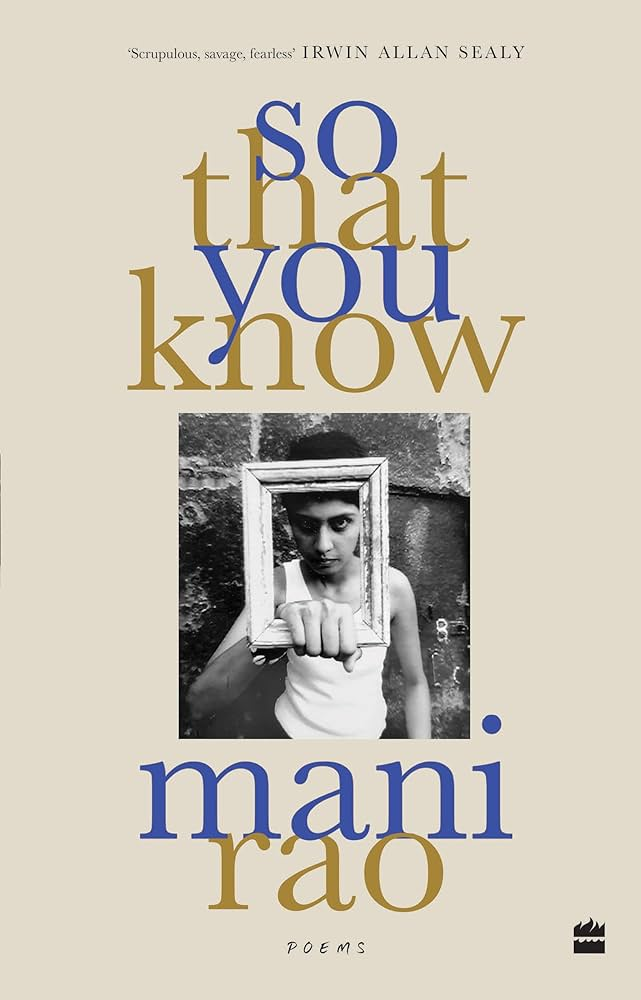
So That You Know (Review)
HarperCollins, 2025, Pp.293
ISBN-13: 978-9369890170
Ranjiet
Reading Mani Rao’s poetry is like hitchhiking on an unexplored road. You may continue or not but before you disembark your journey, you have seen enough of the world to sit and contemplate on the slashdots of life.
I was in a conversation with a friend who was recovering from a personal loss. When I inquired after her, she quoted a line in response: “It's easier to lose someone to death than to life.” She didn't remember the poet but this line had stayed with her. The poetic response deflected my attention to the poet. This is how a good poet penetrates your thought process. Almost strangers yet harbor intimacy in those unsafe moments. Mani Rao’s poetry is quotable. She does not burden you with strange emotions. She clears the clutter, shows you the light and makes you vulnerable only to process difficult emotions. Even the darkest truth is not dispensed as a cold stone to bruise the reader’s face. Rather, as the reader goes through a poem, they are allowed to fiddle with intense moments before coming to terms with them. When “your entire life flashes before eyes,” when you realize “you no longer smile in photographs,” all you need to tell yourself is that “four lines make a door.” When you read her poems, you hear words of assurance.
Tell me you’re lonely I’ll
teach you to bite your nails
I’ll bite your nails (25)
The title ‘So that you know’ is a subtle invitation to pursue these poems in pursuit of sagacity. The collection persuades you to grasp the deeper layers of interplay between knowing and unknowing, between presence and absence, and between life and death. Even when this quest is frustrating, a comic relief is suggested:
Keep the wound lush
Smile in secret
Stay in bed (168)
This collection assembles the poet’s ruminations scattered across the previous eight collections of poetry. She experiments with diverse writing forms such as essay-poem, dialogue, and drawings to explore how the self gathers its thinginess through interaction with people, objects and landscapes. The experimental sizes, shapes and bold/light shades of the text can be used to coax the linguistic signs to suggest the tone, modulation and even mood of the speaker. Musicality is inherent in Mani Rao’s poetry. When you read her poems, your tongue swings in a rhythm. In fact, some poems can be recommended as rehearsals to speak poetically. The poems and drawings are finely juxtaposed to give the impression of a whole, infusing both the act of writing and act of drawing. The drawing is not just an embellishment; instead, it functions as an important visual cue to the semiotic process of unpacking the poem’s tight structure. Each poem is what A.K. Ramanujan would have said “an embroidered black hen.” Each time you unstitch a line, a thought explodes in your mind.
Rao always surprises us with her amazing poetic knack of evoking intense emotions without any tinge of sentimentalization. Often speaking through an objective correlative, she draws our attention to human grief and agony so casually that the reader is unwittingly saved from pathos. Consider this amazing poem:
This Marriage
It’s not too cold, I know,
but I had nowhere else
to keep this overcoat
All my suitcases were full
And my closet overcrowded
So I just let it sit
upon my shoulders (4)
This poem must be taught as a textbook on how an objective correlative functions as a safety valve for both the poet and the reader. While it enables the poet to maintain an emotional distance from the poem, and to the reader, it does facilitate a slow exposure to the stimulus and sustained release of tension. The mundaneness of overcoat lends a casual prop to the poem and simultaneously highlights the way grief is nuancedly lodged in the crevices of daily routine. Once the reader disarrays the casual appearance of the poem, he/she begins to discover the epitasis of its narrative. The apple cart is perfectly pulled and your goosebump is announced when you take off the coat and feel the body and its texture of sensations. Once a coat arrests your thought process and defamiliarizes your perceptions, the softness of your coat is no longer a warmth to you-ineluctably, you are thinking of hot spells in your marriage. The poem both hides and reveals the untraceable anguish that a marriage often embodies.
One recurring tendency in poetry that often frustrates the reader’s epiphanic identification with the poetic voice is the poet’s self-assertion. It is intimidating too. Mani Roa’s ‘I’ is a structural pretension that demonstrates its own fallacy. The ‘self’ in her poems is allusive and exists only in its phantasmagoric stories. The poet fidgets with the multiplicity of the self and seeks its stickiness:
I get together sometimes, a hall of mirrors, swearing different
stories, playing you-know-that-I-know-that-you-know-that-
I-know (196)
Written in a memoiric mode, the poem ‘Island’ spotlights how our life is nothing but our own chosen illusions, and we are often hallucinated by our own choice while the neglected selves often ambush us in our secured villas of silence. The desire to disappear in shelves of silence to escape from “duplicities of oceans and mountains of past and future lives of postures and readers”, if not futile, does steer us towards a different kind of mental stage, a dias where we rehearse our own truths and untruths. This inward journey has its own gains, despite disquieting self-engagement. We realize that this meditation has its own distractions. The search for solitude takes you on a mental space populated with many selves:
You think you are in the middle of nowhere
Count ten and a person
will materialize
A shepherd, farm worker,
random person chewing a tamarind (23)
When our encounter is with playful and unconventional poetry such as Rao’s, perhaps we will end up embarrassing ourselves if we identify a recurrent motif in her poetry and pigeonhole poetic richness into a template. How would you staple the semantic fluidity of death in her poems, especially when its use is polysemic? If in one poem, death is a philosophy of life, in another poem it is an aesthetic choice. Sometimes, it is utilized as a rhetorical device to achieve poetic effects:
Careful when you touch someone
The death spot moves everyday (222)
She does not theologize death nor deploy it as a closure of statement. Death never appears as a clingy attachment that frightens us or drives us into a black hole of nothingness. Rather, it emerges as an impetus to return to life and embrace it with its idiosyncrasies and anomalies. We, human beings with this body that “becomes softer with age,” are “collectable in a dustpan” but uncertainties and vulnerabilities are not wed to death. Instead, this is how our life reinvents itself:
What struggles and dies or survives, thrives, depends
on what, who knows, they are the dervish whirling,
and you, dust (31)
The poet might be “afraid of inconsequential sunsets … days of waking up at 3.33 a.m.” but she does not sulk in despair, instead she writes a love poem at 3.33 a.m. And even in this love poem, the act of telling the brutal truth becomes an intense intimacy, a warmth of enduring love. She places the broken pieces of truth first on her tongue before disclosing it to the beloved one:
I am leaving you
Even in my dreams I am leaving you (34)
This kind of intensity runs through her poems. Each poem demands emotional involvement rather than a mere perfunctory reading. You have to put off your pragmatic guards to be vulnerable to immerse yourself in human emotions SO THAT YOU KNOW what it means to be engrossed in an intense moment. Each poem defies closure, even undermines its own prophecies as if comic relief is the only thing to look up to when nothing matters. Each poem pinches you, makes you shudder but not without epiphany; your sweat and tears clear your vision. And throughout your reading, the poet sagaciously whispers to you:
“Sleep with your fingers open for new sensations” (212)
Author Bio
Ranjiet is a research scholar at University of Minnesota. He writes poetry in English and Punjabi.